Sunday, May 1, 2022

Get Powershell Version : various methods to get the version of Powershell

 There are numerous ways to do the same thing in Powershell. In this post, we will go over every way to check the PowerShell version.  All these ways should work in both Windows PowerShell and PowerShell Core. 


Here are the ways to get the version of PowerShell :

  • The $host.Version property
  • The (Get-Host).Version property
  • The $PSVersionTable.PSVersion property
  • The registry (Windows PowerShell only)

Another method is getting the Powershell version from a remote computer:

Invoke-Command -ComputerName 10.0.0.5 -ScriptBlock {Get-Host} -Credential $cred

results in for example:

Major Minor Build Revision PSComputerName ----- ----- ----- -------- -------------- 1 0 0 0 10.0.0.5


Using $host and Get-Host  command

: Referencing $host.Version is another way to check Powershell version. The $host variable is an automatic variable that returns the same output as Get-Host.


$host.Version on Remote Computers

You will see the same behavior via PowerShell Remoting with $host.Version as you will running Get-Host.

Invoke-Command -ComputerName 10.0.0.5 -ScriptBlock {$host.Version} -Credential $cred


Registry

If you don’t want to open up PowerShell itself, you can also check the registry. The version of PowerShell is tucked away under a value in the registry key path HKLM:\SOFTWARE\Microsoft\PowerShell\3\PowerShellEngine. This registry key has a value called PowerShellVersion that you can reference by using Get-ItemProperty.

(Get-ItemProperty -Path HKLM:\SOFTWARE\Microsoft\PowerShell\3\PowerShellEngine -Name 'PowerShellVersion').PowerShellVersion 5.1.17134.1

Also WMI:

reg query HKLM\SOFTWARE\Microsoft\PowerShell\3\PowerShellEngine /v PowerShellVersion HKEY_LOCAL_MACHINE\SOFTWARE\Microsoft\PowerShell\3\PowerShellEngine PowerShellVersion REG_SZ 5.1.17134.1


Registry on a remote computer:

$scriptBlock = { [version](Get-ItemProperty -Path HKLM:\SOFTWARE\Microsoft\PowerShell\3\PowerShellEngine -Name 'PowerShellVersion').PowerShellVersion } PS51> Invoke-Command -ComputerName 10.0.0.5 -ScriptBlock $scriptBlock -Credential $cred


 Version via $PSVersionTable.

PSVersion property on the $PSVersionTable automatic variable. This method will always represent the PowerShell engine.


Tuesday, January 11, 2022

Export or Bookmark all open tabs from Android to Windows

Here we will try 2 different methods to achieve export and bookmark of all open tabs respectively,

 Export All Open Tabs from Android Chrome to Windows Chrome

1. You'll need to download and install Android Dev Tools on your computer, as well as set your mobile device to Developer Mode. Android Dev Tools can be downloaded and installed here.

We will only require the adb application, but we will still need to install the entire toolbox. Personally, I found it easiest to download and install Android Studio.

2. Put your Android phone in Developer's Mode and connect with a cable to your desktop. 

Here is how to set Dev Mode.

It's best to connect using a USB, because sometimes the device cannot be discovered by adb. Here is an official instruction how to turn it on. Also, you may want to turn on MTP configuration in "Select USB Configuration" menu as described here, otherwise adb may not find your device.

3. Verify ADB can Connect ADB to your phone.

Open CMD, browse to where adb.exe is installed. Run the command:

adb devices:

You should see the output similar as follows:


4. Connect to Chrome Remote Debugger on Android:

Chrome mobile has a feature to expose remote debugger on tcp socket which you can access from your desktop. The so called "legacy" debugging workflow is described in Chrome developers documentation.

It is called "legacy" because now there is more fancy way of debugging mobile Chrome using Chrome Dev Tools.

For our purpose however the "legacy" way is more useful because we get access to a bare text interface in JSON format which gives easy way to extract open tabs URLs.

execute the following cmd:

adb forward tcp:9222 localabstract:chrome_devtools_remote

you should see output as follows::


5. Verify Chrome Remote Debugger connection:
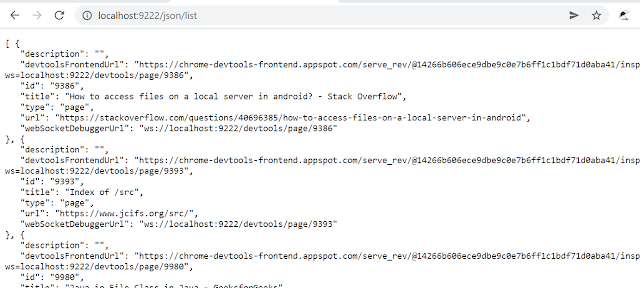
Open Chrome, browse to following URL:

http://localhost:9222/json/list

Output should be similar as follows:


6. Parse the JSON & save to file:

If you have JQ tool installed you could parse this JSON, extract only URLs and save in txt file like that:

Install JQ if not already installed, using Chocolaty or preference:

e.g: 


7. Save JSON as list of links file:


8. Open file, copy and paste all urls as new tabs using Copy Urls or use export file as needed. "Bookmark All Tabs" can then be used to save all bookmarks at once.


 Open All Tabs from Android Chrome to Windows Chrome:

Ensure sync Open Tabs is ON in settings | Manage what you sync:


– Open Chrome on your desktop (you must log into the same account as on your Android Phone/Tablet).
– In a new tab/window, press Ctrl+H.
– Click “Tabs from other devices” and you will see all your opened tabs.


– Click “Actions” or 3 dots.
– Click “Open All” and all your opened tabs from your Android Phone/Tablet should open on your Chrome desktop.
– Press Ctrl+Shift+D to “Bookmark all tabs”.
– Select a folder and click “Save”.


Friday, June 25, 2021

GMail Forward Email for all items in label

/*
Main
https://stackoverflow.com/questions/56023037/forward-email-message-with-mailapp-instead-of-gmailapp
*/
function forwardForever() {

  Logger.log('forwardForever2() START ');
  var labelName = "Trash"

  var threads = GmailApp.search("in:trash label:" + labelName);
  Logger.log('forwardForever2() threads.length ' + threads.length);
  for (var i = 0; i < threads.length; i++) { 
   Logger.log('forwardForever2() forward id ' +  threads[i].getId());
     try
     {
         // try this just in case
        //Gmail.Users.Messages.remove('me', threads[i].getId());
        var firstThread = threads[i];
        var message = firstThread.getMessages()[0];
         Logger.log('forwardForever2() START forward ' + message.getSubject());
        
        message.forward("1@yahoo.com");

        Logger.log('forwardForever2() DONE forward ' + message.getSubject());
        
     }
     catch(e){
        Logger.log('forwardForever2() ERROR id ' +  threads[i].getId());
        Logger.log(e);
     }
     Logger.log('forwardForever2() NEXT...');
    
  }
}

Thursday, June 24, 2021

Android 11 / LG Bloatware Uninstall/Disable to boost performance

 Android 11 / LG Bloatware Uninstall/Disable to boost performance :

Use as needed:


Adb Commands : Uninstall & Disable

https://www.xda-developers.com/uninstall-carrier-oem-bloatware-without-root-access/

https://www.droidwin.com/remove-uninstall-bloatware-apps-from-android-via-adb-commands/#Disable_Bloatware_Apps_on_Android

1. Disable:

Adb shell | pm disable com.lge.lgfota.permission

pm disable-user

2. UnInstall:

1. adb shell pm uninstall com.att.mobilesecurity

2. adb shell pm uninstall --user 0 com.att.mobilesecurity

These two flags respectively specify that the system app will only be uninstalled for the current user (and not all users, which is something that requires root access) and that the cache/data of the system application will be preserved  

3. pm uninstall -k --user 0 com.android.service

keep app data

Disable OTA Updates:

1. Adb shell | pm disable com.lge.lgfota.permission

2. Developer Options | Disable Automatic Updates

3. Package Disabler | Disable LG Update Center

V60 Remove Bloatware

See :

https://forum.xda-developers.com/t/no-root-needed-remove-bloatware-from-lg-v60-tmobile-or-att.4244333/

*TMobile Bloat

pm uninstall -k --user 0 com.tmobile.pr.mytmobile

pm uninstall -k --user 0 com.tmobile.m1

pm uninstall -k --user 0 com.tmobile.pr.mytmobile

pm uninstall -k --user 0 com.tmobile.pr.adapt

pm uninstall -k --user 0 com.tmobile.rsuadapter.qualcomm

pm uninstall -k --user 0 com.tmobile.rsuapp

pm uninstall -k --user 0 com.tmobile.rsusrv

               *Google/FB Bloat

pm disable-user com.nextradioapp.nextradio

pm disable-user com.google.android.music

pm disable-user com.google.android.videos

pm disable-user com.google.android.videos

pm disable-user com.google.android.videos

pm disable-user com.google.android.videos

pm disable-user com.facebook.system

pm disable-user com.facebook.appmanager

pm disable-user com.facebook.katana

                 *LG Bloat

pm uninstall -k --user 0 com.lge.theme.highcontrast

pm uninstall -k --user 0 com.lge.qmemoplus

pm uninstall -k --user 0 com.lge.qhelp

pm uninstall -k --user 0 com.lge.qhelp.application

pm uninstall -k --user 0 com.lge.bnr

pm uninstall -k --user 0 com.lge.bnr.launcher

pm uninstall -k --user 0 com.lge.music

pm uninstall -k --user 0 com.lge.email

pm uninstall -k --user 0 com.lge.exchange

pm uninstall -k --user 0 com.lge.sync

pm uninstall -k --user 0 com.lge.ia.task.informant

pm uninstall -k --user 0 com.lge.leccp

pm disable-user com.google.android.apps.tachyon //google pay

pm disable-user com.lge.fmradio

pm disable-user com.lge.lgbroadcastradioservice

pm uninstall -k --user 0 com.lge.lifetracker

pm uninstall -k --user 0 com.lge.lgworld

-- MISC TODO (Optional for me)

*Google Bloatware

pm uninstall -k --user 0 com.google.android.googlequicksearchbox

pm uninstall -k --user 0 com.google.android.gm

pm uninstall -k --user 0 com.google.android.apps.tachyon

pm uninstall -k --user 0 com.google.android.music

pm uninstall -k --user 0 com.google.android.apps.docs

pm uninstall -k --user 0 com.google.android.apps.maps

pm uninstall -k --user 0 com.android.chrome

pm uninstall -k --user 0 com.google.android.apps.photos

pm uninstall -k --user 0 com.google.vr.vrcore

pm uninstall -k --user 0 com.google.android.youtube

pm uninstall -k --user 0 com.google.android.videos

pm uninstall -k --user 0 com.google.android.talk

pm uninstall -k --user 0 com.google.android.apps.books

pm uninstall -k --user 0 com.google.android.apps.magazines

pm uninstall -k --user 0 com.google.android.apps.plus

* amazon

pm uninstall -k --user 0 com.amazon.mShop.android

pm uninstall -k --user 0 com.amazon.fv

pm uninstall -k --user 0 com.amazon.kindle

pm uninstall -k --user 0 com.amazon.mp3

pm uninstall -k --user 0 com.amazon.venezia


Enable Chrome+Edge Flags

chrome://flags/#smooth-scrolling

chrome://flags/#heavy-ad-privacy-mitigations

chrome://flags/#heavy-ad-privacy-mitigations

chrome://flags/#enable-android-dark-search

chrome://flags/#enable-force-dark

chrome://flags/#heavy-ad-privacy-mitigations

chrome://flags/#enable-zero-copy

chrome://flags/#enable-gpu-rasterization

chrome://flags/#smooth-scrolling

Friday, June 11, 2021

Android Disable System Updates : Disable the message "Install update keep device running smoothly"

Stop the "Install update keep device running smoothly" message"; 
  1. How do I stop google play services auto update? 
Yes it is possible to stop it from auto updating itself.follow these steps to do that:-


. Go to setting


. Tap on data usage option


. Scroll down and find Google play services


. Tap on it then scroll down and put a check on Restrict background data option


. Now it's only update when you manually update it.


. You can use this method for any app and also revert it anytime.

 OR 

  2. Block System Update 


To do it follow these steps if you are on Lollipop or higher.


The update notifications usually comes on your notification bar and cannot be removed by swiping to left or right. You can either skip it by giving a time limit.

When the notification comes, pull down the notification pannel and long press on the update notification.

You will see a setting logo to the right side of the notification.

Press that and go the update notification settings.

There will be a toggle for blocking all notification from this app. Turn on that toggle and you won't get any more notifications.


 OR 

  3. Option 3 

Go to Settings > Apps.

Navigate to Manage Apps > All Apps.

Find an app called Software Update, System Updates or anything similar, since different device manufacturers have named it different.

To disable system update, try any of these two methods, the first one being recommended:

Tap Turn Off or Disable button and then OK.

In case this button is grayed out, tap on Force Stop > OK to turn the process off temporarily. In such case, there is a possibility that the app may turn on automatically

Disable any update notifications by unchecking “Show Notifications” checkbox in supported devices.


And Android Apps in general, more info here
https://www.alphr.com/disable-updates-android-device/